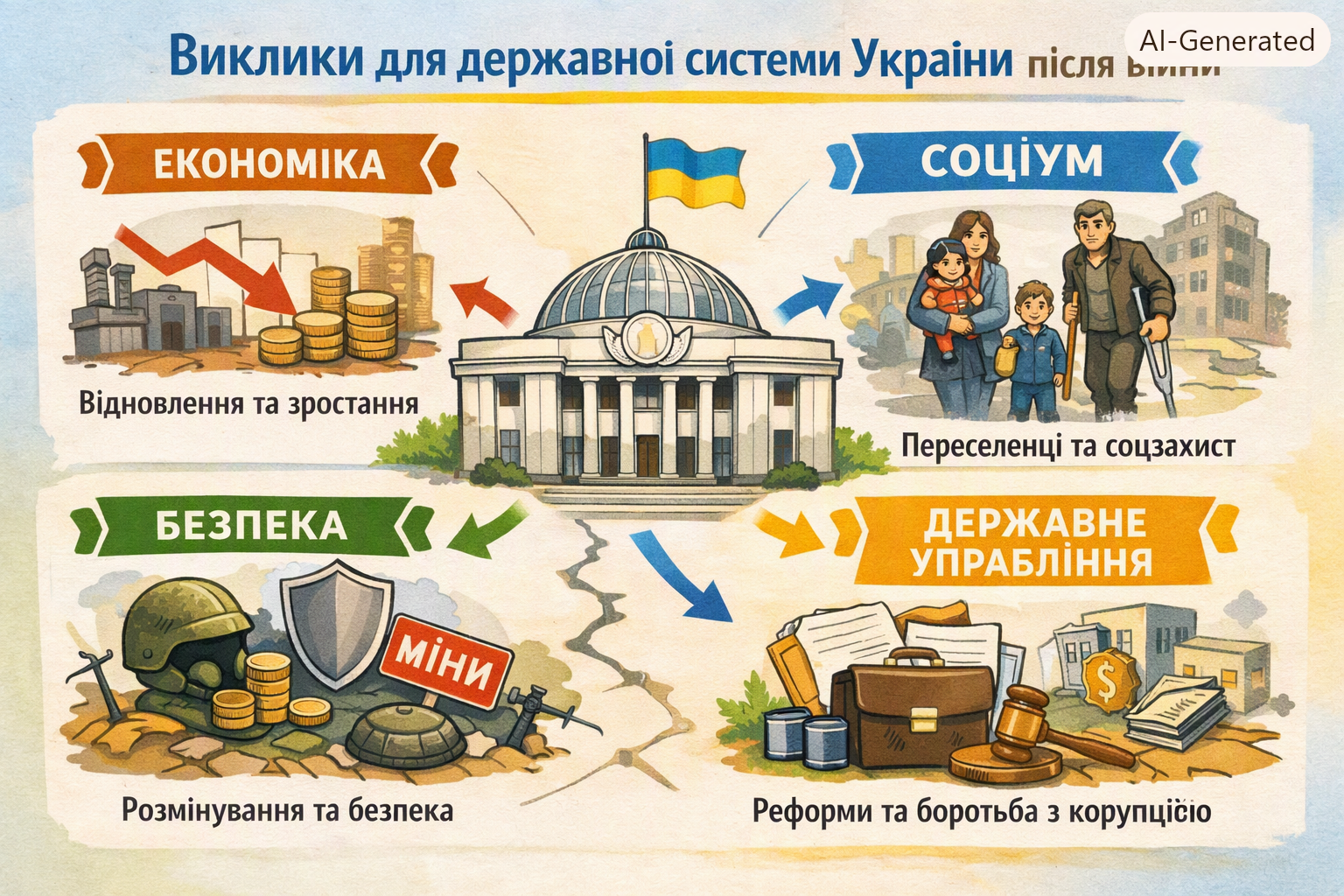
In this main topic “consequences of war” me propose is to reject the tough
question: will we be exist in the results of war? That is, we – are citizens and non
citizens of Ukraine, when we were over 50 million people, even when we became
20-30 million. What do we see our state, our Ukraine? What should change and what
will remain in the state system. How will the structure of state administration
change?
A weak state apparatus exposes the state to new risks of encroachment by
neighbors. Therefore, in addition to restoring the infrastructure, it is necessary to
resolve the issue of its effectiveness. The apparatus must be able to manage state
processes. However, at the same time, not all the shortcomings of the previous
system will disappear, and perhaps they will dictate the future state model after the
war. I would not like to see such a scenario implemented, since everyone, as we can
see, is already tired of hearing and reading about the endless stream of corrupt
officials, bribe-givers and bribe-takers…, bandits of various kinds, which our current
press is reporting on in a hurry… Journalists do not think about who reads them, since
they “catch” yellow or black ducks in the foggy sea of misfortunes of our people.
The reform of outdated ineffective systems can be actively resisted by
volunteer structures, various NGOs, which have taken some over state functions
since 2022.
In the future, Ukraine will rely, as is already happening now, on the military,
which will provide rear protection, security, reliability of existence and
development. Such a formula assumes a symbiosis of the presidential power
structure with the military. Perhaps a military-presidential model of governance will
be formed, where the position of president will be held by a civilian, but the
government and specialized ministries will be headed by military strategists and
tacticians, economists, IT specialists, and specialists in a number of issues related to
the development of the necessary branches of science and technology necessary for
the restoration of the destroyed economy. In the parliamentary situation that we are
currently observing in Ukraine, forces that could take responsibility for the future of
our state have not yet emerged.
The new governance system will require amendments to some articles of the
Constitution of Ukraine, cleansing the apparatus of corrupt and unprofessional
people, eliminating ineffective structures, etc. Ensuring transparency of government
activities, professionalism, decency, and direct dialogue with people will be
gradually implemented. With the restoration and strengthening of the state, the need
to return to a classic presidential-parliamentary republic or parliamentary
presidential…
Ukraine has demonstrated a rare phenomenon in history during times of war:
active support, trust and unity of society with the authorities in a fair fight against
the enemy.
Our state is moving up the steps of European integration, gaining security
European integration through increased cooperation with European institutions and
synchronization of national defense, law enforcement and civil protection systems
with the institutions of the European Union.
At the same time, the areas of security integration are concentrated in the
Common Security and Defense Policy (CSDP), which provides Ukraine as a
candidate country with the opportunity to participate in EU military missions,
demining activities and military-technical cooperation; in strengthening borders and
customs: implementation of integrated border management, data exchange with the
European Border and Coast Guard Agency (Frontex) in the fight against cross
border crime and smuggling; cybersecurity and infrastructure resilience through the
unification of standards for the protection of critical infrastructure and countering
disinformation in accordance with European Union policies.
We also observe law enforcement cooperation in deepening interaction with
the EU Agency for Law Enforcement Cooperation (Europol) in investigating
international crimes; as well as troop mobility – a simplified procedure for the rapid
movement of military personnel and equipment across the territory of the European
Union. The requirement from Ukraine, at the insistence of the President of Ukraine
V. Zelensky, to simultaneously open all clusters of negotiations on accession to the
European Union in 2026, is explained by the attitude of our state to the EU as
ensuring national sovereignty and a stable “security shield”.
Ukraine has the right to such step, since it protects the European Union from
a potential aggressor, has deepened economic cooperation with the countries of the
European Union, as a result of which more than half of Ukrainian exports go to the
countries of the European Union. The above is the best confirmation that the
Ukrainian economy is an integral part of the European economic space. As a result,
the negotiation process is based not only on political will, but also on the results of
many years of reforms. Ukraine is deservedly and positively leading the negotiation
process for EU membership. It does not ask for exceptions or simplified procedures.
It is moving forward quickly because it is implementing the necessary reforms. It
proves that European integration is a joint investment in the security, stability and
future of both Ukraine and the entire European Union.
As strange as it may sound, we note that the mobilization of all forces for
war also has positive aspects, which were manifested in strengthening the security
of the state, the development and creation of modern armed forces, the
modernization of the economic sphere, the development of science and technology,
the introduction of IT technologies and the know-how of modern scientific
developments.
The modern Armed Forces of Ukraine are becoming the most combat-ready
army in Europe and will be a bulwark of regional security. Post-war Ukraine with a
strong army can be the main ally of the United States in the region.
Although constant security mobilization is necessary to preserve the state,
the reduction of human resources threatens a demographic crisis. At the same time,
the implementation of the project to attract foreign labor to Ukraine, from African
countries, as practice has proven, has not met the expectations of the authorities.
Unfortunately, Ukraine needs to look for replenishment for the army. As an example,
we have let’s name several centers that successfully conduct agitation to entere
among their ranks new forces to study unmanned systems, and so on.
With the end of the active phase of the war, Ukraine, as we see, will be forced
to reform the structure of state power: both the legislative branch and the executive
sector. Ukraine should become a military state, possibly with a mixed system of
power. Most likely, it will be necessary to build a state system with military
democratic principles with the existing presidential-parliamentary core, reinforced
by the military; a professional defense industry, strengthened by business, as a
strategic pillar of the entire economy, and a strong security sector.
Liudmyla D. Chekalenko